Use for Risk Awareness events, leadership & Board training, skills refresh, & more!
Navigate Risks with Confidence

Use for Risk Awareness events, leadership & Board training, skills refresh, & more!

After many years leading Enterprise Risk Management programs, I learned something surprising. Organizations are usually capable of identifying risks. But they are often challenged in having the conversations that lead to better decisions about those risks. That's why I founded The Risk Case Study Guy.
Our aim is to help individuals and organizations better navigate risk and uncertainty. We provide engaging and insightful services tailored to build our client's understanding, awareness, and buy-in of the practice of risk management.
We offer online and onsite training, presentations, and consultations responsive to your needs, designed to help you and your organization elevate your risk management capability. Our approach makes learning about risk management interesting, relevant, and accessible! SAM.gov registered

We can help strengthen and elevate your risk program so that your organization doesn't become its own case study.
We take the time to understand your needs before recommending a service.
Our experience comes from developing and leading successful, award-winning risk management programs.
Making risk management work for clients is our aim! We are here to help!
Stunned tourists watched in disbelief in October 2025 as more than $100 million in gold, diamonds, and emeralds were stolen in broad daylight from the Louvre. The heist of France's royal jewels became front-page news worldwide after thieves used a ladder to access the museum and fled on scooters with the treasures in less than 8 minutes. Despite these shocking events, it was revealed that the Louvre staff had been aware of the museum's security vulnerabilities for decades. Recent risk assessments had even warned about these issues just days before the robbery. An array of factors, including misplaced priorities, underestimated risks, ineffective governance, and obsolete protocols contributed to the failure to navigate risks effectively.
On March 26, 2024, at 1:29 a.m., the containership Dali was navigating the waters out of Baltimore Harbor when it lost power and collided with the Francis Scott Key Bridge. This tragic incident caused a significant portion of the bridge to collapse, resulting in the deaths of six construction workers. For over two decades, a safety and coordination committee had warned of the growing dangers posed by increasingly larger cargo ships. They repeatedly highlighted the potential for a collapse if the bridge were struck, but these important warnings regarding the need to navigate risks went unheeded. When Maryland officials were questioned following the collapse, they stated they had relied on the committee to recommend actions for consideration. However, when pressed for specifics, none could recall being briefed about the committee's discussions.
Preservationists developed a complex, comprehensive, and expensive risk prevention and mitigation system to navigate risks for the centuries-old Cathedral. Unfortunately, this system failed spectacularly before a worldwide audience in April 2019, when a fire nearly consumed the structure. Factors such as faulty assumptions, complacency, overconfidence, and other lapses contributed to this near calamity, highlighting the importance of thorough risk analysis and effective risk management.
The second largest bank failure in U.S. history occurred in March 2023, triggered by a classic run on Silicon Valley Bank, amplified by social media and driven by rapidly rising interest rates, poor risk management, and a highly concentrated, uninsured depositor base. Oversight lapses by the Federal Reserve and the FDIC failed to navigate risks associated with excessively risky bank practices until it was too late. More effective risk management and better risk governance could have reduced the likelihood of the bank's collapse.
Tens of thousands of Maryland parents relied on the state's 529 plan to save money for their children's college education. However, in 2021, software mistakes and errors by fund management led to incorrect account balances and statements, resulting in a freeze on accounts. Families received no advance notice, forcing them to scramble to pay tuition bills amidst surprise reductions in their account balances and ever-changing explanations from the agency. The Maryland General Assembly grew increasingly frustrated with the mismanagement, ultimately leading to the abolishment of the entire Board of Directors and the transfer of the 529 program to the State Treasurer's Office.
Hundreds of vehicles and thousands of people, including a U.S. Senator, were left stranded on I-95 in Virginia overnight in January 2022 due to a complete breakdown in emergency preparedness and response efforts during a predicted snowstorm. The chaos was compounded by lingering impacts from COVID, unrecognized changes in the risk landscape, and failures in situational awareness. To effectively navigate risks, it’s essential to keep risk management and mitigation plans current, and to test your capacity to act in the face of simultaneous risk events.
Despite having an extensive Enterprise Risk Management program designed to help navigate risks, it ultimately proved ineffective. Leaders at Wells Fargo intentionally overlooked and dismissed warnings in pursuit of directives and incentives that led to harmful outcomes, including thousands of harmed customers and hundreds of wrongfully terminated employees. A thorough risk assessment revealed significant deficiencies in their approach. It took years for Wells Fargo to recover from this scandal, to rebuild its tattered reputation, and to revamp the bank's risk culture, incorporating better risk governance practices to prevent future issues.
Check back again -- new case studies on how to navigate risks through effective risk analysis and risk assessment are regularly added.
Every person has a risk type that reflects their predisposition to risk and influences how much risk and uncertainty they can cope with. For example, are you wary, prudent, carefree, deliberate, composed, etc. in your approach to risk? These and other Risk Types affect how we perceive and react to risk. Risk type also exerts an influence on our decisions. By learning about our own risk type, we can gain a better understanding of how we are likely to manage different types of risk. By learning about the risk types of our teammates and colleagues, we can gain unique insight into how the mix of risk types present (or missing) in our team shapes the way risks are handled in our organization.
The Risk Case Study Guy is certified to use the Risk Type Compass assessment to facilitate individual and team awareness of risk disposition.
Simply request a consultation with the Risk Case Study Guy to learn more about the Risk Type Compass, and options for using the assessment for yourself or for a team.
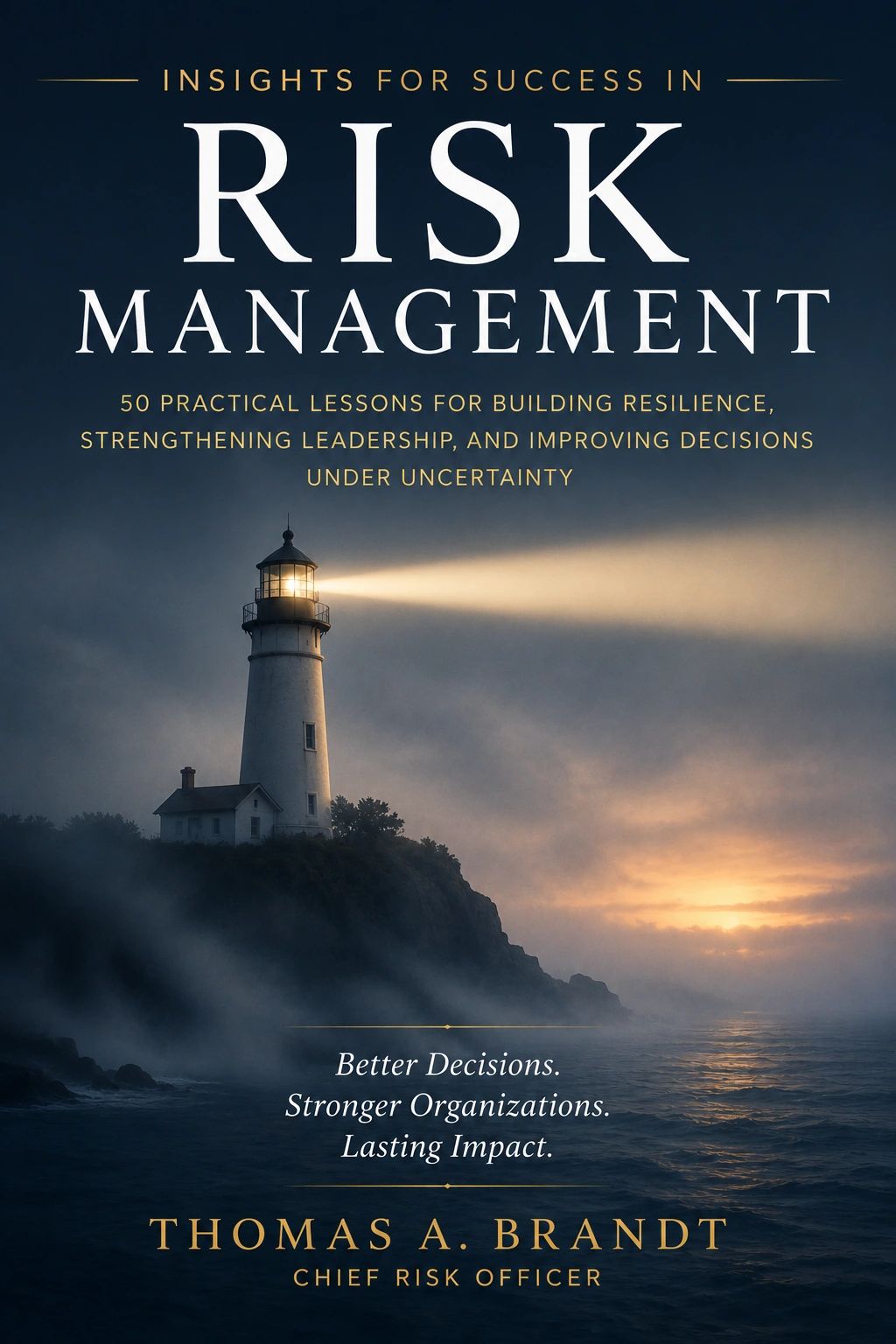
Through fifty practical insights drawn from real-world experience, this book explores what truly makes Enterprise Risk Management successful—from building strong foundations and navigating organizational challenges to developing professional judgment and creating lasting organizational value.
Inside you'll discover fifty practical insights on:
Enterprise Risk Management creates value when it helps organizations make better decisions under uncertainty.